photography and preservation
How to Preserve Old Family Photographs So They Survive the Century
Scanning is the easy part. Everything that makes a photograph meaningful happens afterwards.
By The Memorivos Curators · · 8 min read
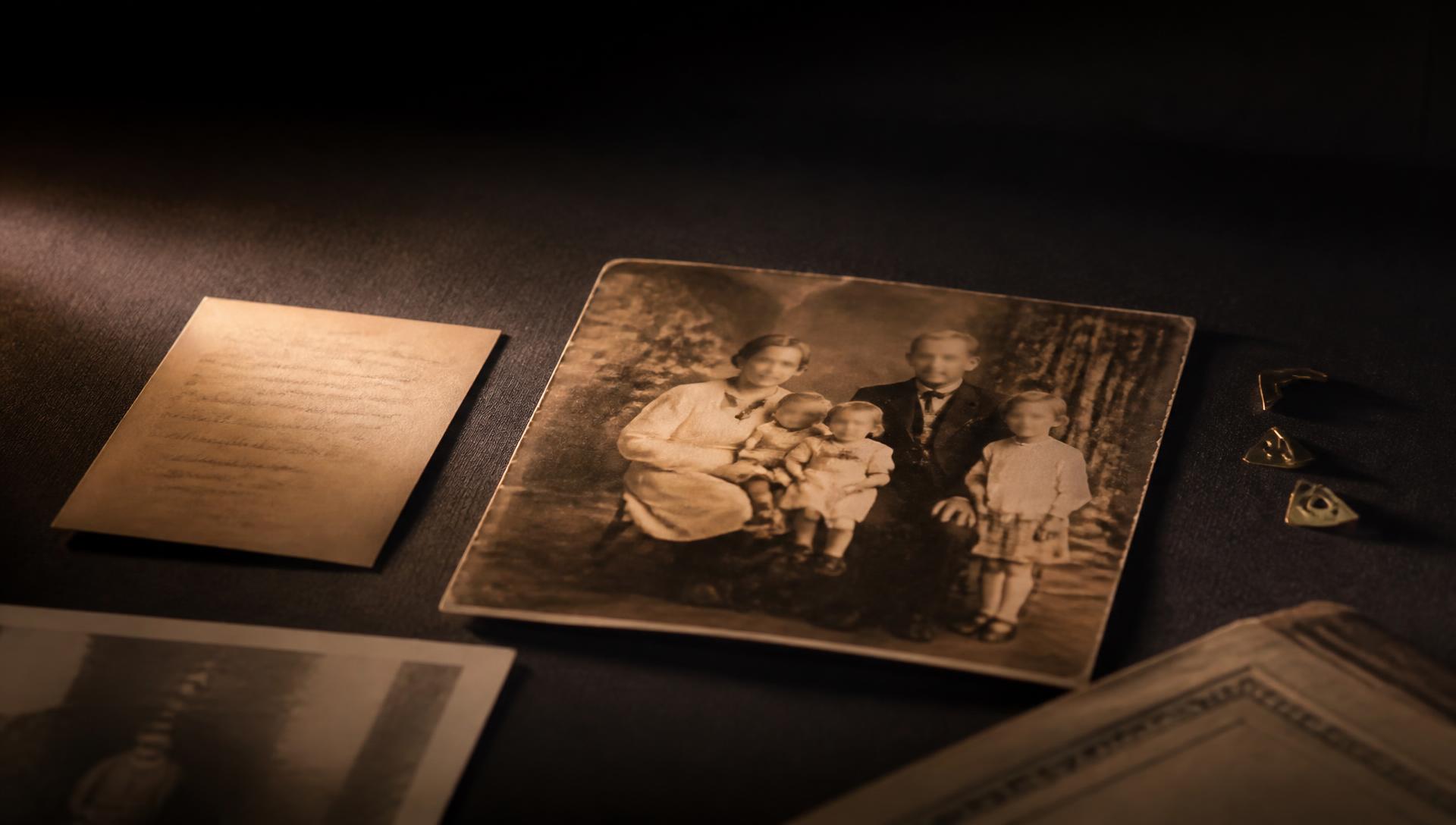
Somewhere in most families there is a box. Loose prints, a few albums with adhesive that has gone brown, a wallet of negatives nobody has looked at since they were developed. Everyone agrees something should be done. Nobody knows what.
Here is what to do, in the order that matters.
First, do no harm
Before any equipment is involved, stop the damage that is already happening.
- **Get them out of the loft and out of the cellar.** Heat, cold and damp destroy more photographs than handling ever will. An interior cupboard on a middle floor is better than either.
- **Remove them from magnetic albums.** Those self-adhesive pages with clear film are the single worst enemy of twentieth-century prints. If a photograph lifts with gentle pressure, lift it. If it resists, leave it and scan it in place — tearing is worse than waiting.
- **Handle by the edges.** Skin oils etch slowly into emulsion.
- **Take off the paperclips and rubber bands.** Metal rusts into paper; rubber turns to acid.
- **Never write on the back with a ballpoint pen.** Pressure marks come through the image. A soft pencil in the margin, or better, a note beside the digital copy.
Then, scan properly once
Scanning twice is a waste of a life. Do it once at a standard you will not need to revisit.
**Resolution.** 600 dpi for standard prints. 1200 dpi for anything smaller than a postcard, and for anything you may want to enlarge. Negatives and slides need 2400 dpi or higher, and a scanner with a backlight — a flatbed alone cannot do it.
**Format.** Save the master as TIFF or PNG. Make JPEGs afterwards for sharing. A JPEG loses a little every time it is saved; the master should never be edited.
**Do not let the scanner improve anything.** Turn off automatic colour correction, dust removal and sharpening. They discard information permanently. Restore later, from an untouched master.
**Phone cameras are acceptable.** A phone in flat daylight beside a window, held square to the print, is far better than nothing and better than a bad scan. Photograph the back too if anything is written on it.
A perfect scan of an unidentified stranger is worth less than a mediocre scan of a named grandmother.
The part everyone skips
Labelling is preservation. An unlabelled photograph has a lifespan of roughly one generation — as long as somebody living recognises the face.
For each image, capture as much of this as you can:
- **Who.** Full names, including maiden names, left to right.
- **When.** An exact date if you have it, otherwise a decade. "Probably early 1950s" is real information.
- **Where.** Town and country at minimum.
- **What.** One sentence. *"The morning they moved into the flat on Cardigan Street."*
- **Who says so.** Note whether the identification is certain or a family guess. Future generations deserve to know the difference.
Do this while someone who remembers is still able to tell you. It is the only step with a deadline.
Storing what survives
**The originals.** Acid-free boxes, upright, in stable indoor conditions. Interleave with acid-free paper if prints are stuck together. Keep them out of direct light entirely.
**The digital copies.** Follow the rule archivists use: three copies, on two kinds of storage, one of them somewhere else. A drive at home, a second drive at a relative's house, and a cloud copy satisfies it. A single computer does not. Neither does a single phone.
**Check every few years.** Open a handful of files. Confirm they still open. Copy everything to fresh storage roughly every five years, because storage media fail silently and on their own schedule.
Restoration, carefully
Digital restoration can lift a faded print astonishingly well, and modern tools can now invent detail that was never there — a plausible eye, a smoothed cheek, a face that is not quite the face.
Restore contrast, colour and damage. Be cautious with anything that reconstructs a person. And always keep the untouched original beside the restored version, clearly marked. A repaired photograph is a valuable thing. A repaired photograph mistaken for evidence is a problem for whoever comes next.
One box at a time
You do not need to finish. Twenty photographs scanned and named this month is a permanent gain; a plan to do all four hundred next year is not.
Start with the oldest ones, and the ones with people nobody younger can identify. Those are the ones with a clock running.
- photographs
- preservation
- family history
- archiving