legacy and reflection
Why a Life Deserves a Museum, Not a Folder
We built the wrong container for the most important things we own.
By The Memorivos Curators · · 6 min read
Consider two ways of keeping the same forty photographs.
In the first, they sit in a folder called *Scans_2019_final_v2*, ordered by filename, viewed as a grid of thumbnails, opened perhaps twice in a decade.
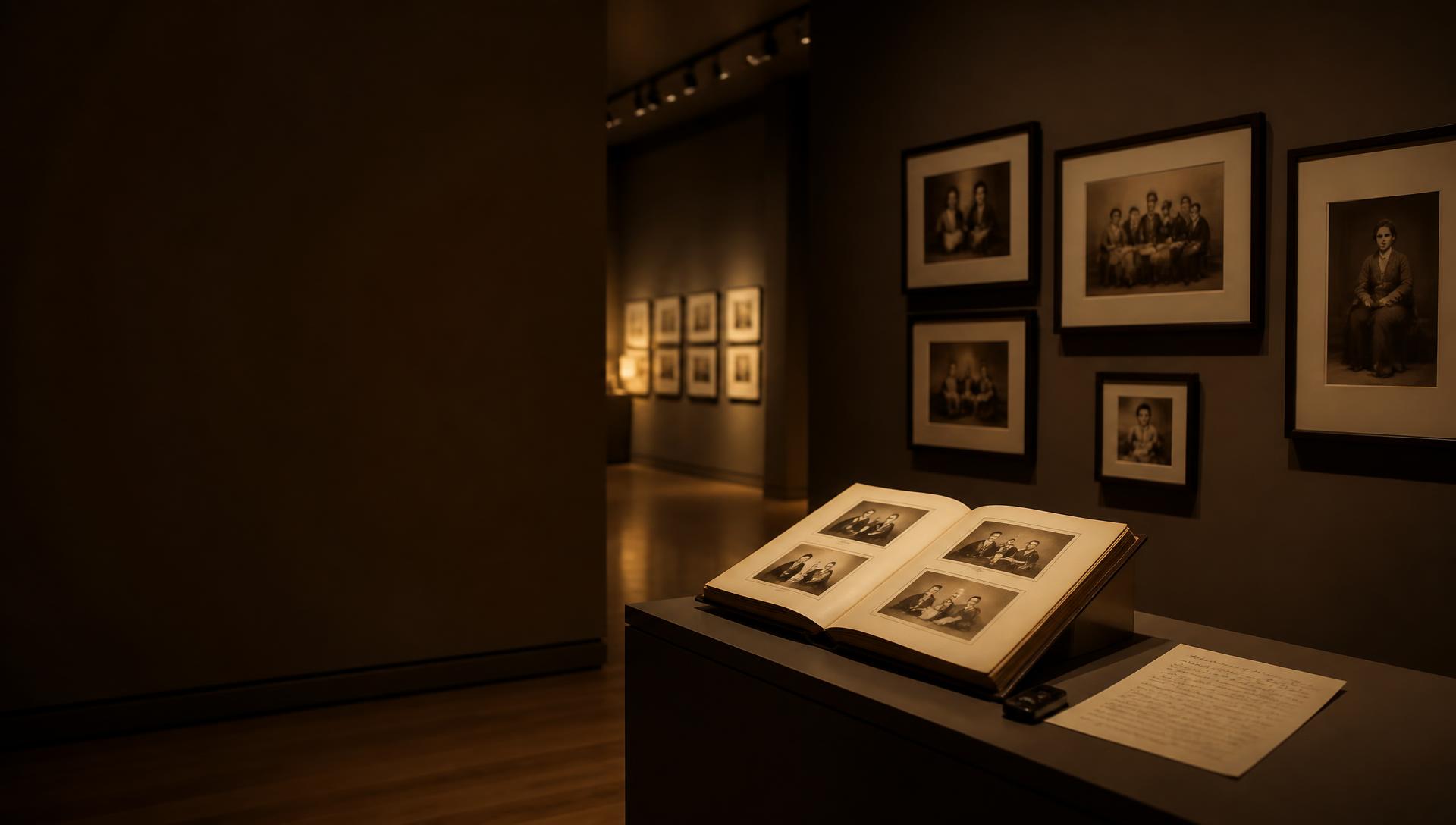
In the second, they hang in a room. The early ones near the entrance. Your grandmother has a wall to herself. Beneath each frame there is a short line explaining who is in it and why it mattered. You walk in, and you slow down.
Nothing about the photographs has changed. Everything about your relationship with them has.
Storage solved the wrong problem
Cloud storage is an extraordinary technical achievement and an almost total failure of design for memory. It optimises for the things memory does not need — capacity, retrieval speed, syncing — and ignores the things it does.
A folder has no hierarchy of importance. The photograph of your father's last birthday sits beside a screenshot of a train ticket, identical in weight.
A folder has no context. Filenames are not sentences. Dates are not stories.
A folder has no threshold. You do not enter it; you open it, glance, and close it. Nothing asks you to be present.
We treat our most precious material exactly as we treat our least: as files in a list, sorted by when they arrived.
What a museum does differently
Museums are not buildings that happen to contain objects. They are a technology for attention, refined over three hundred years, and they do four things a folder cannot.
**They select.** A museum shows a fraction of what it holds. The act of choosing is what creates significance — everything cannot be important, so something can be.
**They arrange.** Objects are placed in relation to one another. Sequence carries meaning that no individual item holds alone.
**They explain.** The plaque beside the object is not decoration. It is the difference between a jug and *a jug carried from Cork in 1912*.
**They slow you down.** Architecture, distance and silence all say the same thing: this is worth your time. Nobody scrolls through a gallery.
Applied to a family
Arrange a family archive the way a curator would and the effects are immediate.
You are forced to choose a hero. Which single photograph represents this decade? The question is uncomfortable and clarifying, and answering it produces something no algorithmic "memories" feature ever will.
You are forced to write the plaque. One sentence beneath each image. This is the highest-value preservation act available to anyone, and a museum layout demands it where a folder does not.
You leave space. Empty wall is not wasted; it is what makes the occupied wall legible. A grid of two thousand thumbnails has no empty wall, which is why it produces fatigue rather than feeling.
You can bring someone in. "Let me show you" is a sentence that works in a room and does not really work in a folder.
The inheritance argument
There is also a practical case, and it is the stronger one.
A folder of ten thousand unsorted files is not a gift. It is a task, handed to grieving people, which most of them will never begin. The archive survives, technically, and is never opened.
A curated room of two hundred captioned photographs is inheritable. It can be walked through in an afternoon by someone who never met the people in it, and they will come out knowing them.
The measure of a family archive is not how much it holds. It is whether a great-grandchild would voluntarily spend an hour inside it.
Beginning with one room
You do not need software to test this. Take one shoebox. Choose thirty photographs — only thirty. Put them in order. Write one line beneath each.
You have just built a room. It took an evening, and it will outlast every folder you own.
Everything after that is only more rooms.
- legacy
- preservation
- storytelling
- family history